Latest Event Updates
Make It Through The First Draft

Writing a novel can be overwhelming. If it’s your first, you may not think you can make it. This is a vulnerable time. Writing is not a sprint. It’s an endurance test. Whether you’re a planner or a panzter the process can play tricks on your mind. You agonize over the right word. You start to feel down on your story, your writing and yourself. This is toxic.

Shut down that inner critic. This is not the place to agonize, pick or poke the quality of your writing. Editors, agents and future drafts all await you. When you start to think, “Who am I? No one will want to read this.” or “It’s impossible to get published.”, you feed into a track of negative self-talk. Once you believe it, you’ll be tempted to stop. You will want to avoid writing or you’ll put it off for another day, when you feel like it.

Thing is, you’ll never feel like it if you can’t tamp down the demons. Writing is your job. You won’t wade through the ocean in a day, will you? Nor will you finish the novel by worrying the first draft isn’t good enough.

Guess what? It’s supposed to be bad. Just get the words down. Keep going, don’t think about submissions. That should be the furthest thing from your mind.

Try to float through insecurities, keep writing. If you can get to the next page and the next before you know you’re done with that first chapter. Once you’ve done one chapter you can do two, if you make it to the dreaded half way mark, keep going. Don’t talk about your work or your story. Keep the fires of creativity stoked with a need to get the plot on paper. Writers who talk about their work grow bored. Talk too much about the details and you’ll find enthusiasm waning just when you need that the most.

It you write your story linear, turn off the harsh inner critic and keep juicy details to yourself, the momentum will carry you through the worst first draft malaise your mind can ever dish up. You’ll have you’re first draft done, and hey your a novelist. Now you get to edit that sucker.

Lermontov A Hero in His Time and Ours

He lived nearly two hundred years ago. The novel Mikhail Lermontov left us sparkles as a portrait of the Byronic hero. Pechorin is bored, he’s sharp-tongued, calculating and a little desperate, nay impulsive. He’s sensitive, but self destructive too. A contradiction, the supreme anti-hero.

So what is this superfluous man? In Russia, it’s more than dandyism. The archetype was made popular by Turgenev in his novella, Diary of a Superfluous Man. He disregards societal norms, he’s cynical, unempathetic and enjoys rubbing others with his pursuits, the big three: gambling, dueling and romantic escapades. He’s not just a one-dimensional fop. He’s a symbol. An exponent of the Tsar Nicholas I’s reactionary policies. These men refused a useful life they didn’t believe in so they gave themselves over to a rakish passivity. The superfluous man is lost, he’s not riding the character arch to win the game. He’s thrown his hand in before he ever started. Much of this literary type can be traced to the peculiar socio-political climate of 19th century Russia. Russia didn’t have a renaissance or a reformation. Thus the history of it’s literature has always been a vehicle for social change before entertainment. Lermontov does both.

Hero for Our Time is set against the beauty of the Caucuses Mountains. The structure consists of five novellas with differing points of view. The most compelling scene depicts a duel. Dueling in Russia at this time was rife and deadly. Pushkin himself was killed in a duel. The government outlawed the practice but duelers always found a secret place and a way to carry on the duel, little caring they could face arrest if they were discovered.
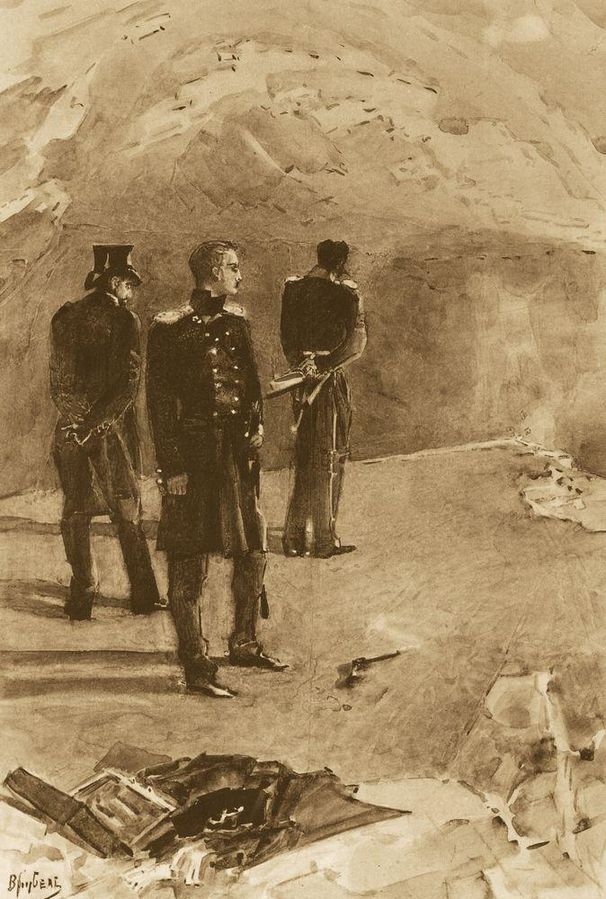
What makes Hero so vivid is the duel is set on a cliff. The idea is almost ridiculous, so over the top that it couldn’t be real. But that’s the point. Lermontov wanted to set his duel in a way that would be memorable.
Kyoto A City in Bloom

To my mind there is nothing so beautiful as the ancient city of Kyoto. The shogun had Edo, but Kyoto was fit for an emperor.

Kyoto is full of stories and ghosts. It has a dash for the dramatic too, with thousands of shrines and temples, it is the sacred heart of the country where a bloodied samurai once hid out in a cabin after an assassination attempt for his part in modernizing Japan.

One of the most famous shines is Fushimi Inari Shrine, a tantalizing spectacle for the eye you’ll want to get lost in. The shrine showcases thousands of jaw-dropping bright torii gates, you wind your way through to get to the shrine. This is one place where the journey really counts.
Kyoto is also home to Gion, the traditional Geiko district. If you hang out, or are lucky you might see the Geisha as she scoots to her engagements around the old city streets.

There are tourist traps in Kyoto like any other city, but if you want to mingle with real Geisha you’ll need to be invited to a prestigious tea house, and if you’re George Bush or a wealthy industrialist you might have a chance, though it won’t guarantee you entry. Yes, it’s that hard.

Fall is one of the best times to see Kyoto. The maple tree is well-cultivated and nothing is more breath-taking than seeing the fiery show of these beauties as they change with the seasons.

Autumn is also a great time to grab a sip of plum sake, and head for Gion for more Geisha-watching, because you’re not important enough to enter the tea house.
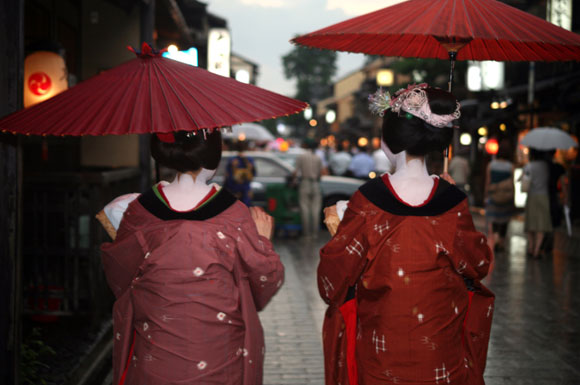
Shrines. Geisha. History and bloodied samurai. Yet, nothing says Kyoto like cherry blossoms. Hanami is the very best time to visit Kyoto.

You’ll see lots of Geisha if you go to Kyoto during cherry blossom season, so go and rejoice. Grab your camera, but keep a respectful distance. You’re in Kyoto and you’ll have to be happy with a look on the outside. If you’re David Bowie, you might get into the tea house.
Japanese Woodblocks; A courtesan’s Best Friend

The woodblock was a Chinese import Japan took to her heart. The art existed before moveable type, but arrived late to the island nation. Ukiyo-e artists of the so called floating world flourished during the 17th Century and beyond. The floating world refers to the dominant culture in Edo celebrating beautiful women of the Yoshiwara, kabuki actors, history, and natural landscape.

The most famous artists, Utamaro, Hokusai, Harunobu and Hiroshige created a stir by publishing series dedicated to the most famous courtesans of the day. Tamigeko. Takao. Katsuyama. All sat for woodblock masters and became household names.

There was no better buzz or copy than to sit with a Ukiyo-e master. If a girl was really famous, the woodblocks created a stampede in front of the printer’s store, with no time for ink to dry. They were revered and treasured by men who dreamed of a night with the famous Takao. A sort of Edo Tigerbeat Magazine.

Rivals dared each other to sell out woodblocks faster, the winner declared the most desirable of her day. The brothels loved this free publicity because it drove up the prices of the girls. The woodblocks became collectors items and courtesans rose in the ranks on the strength of her sales alone. It was whispered that a woman who could sell out all her woodblocks, in record time, must be special indeed.

Kabuki actors were also popular topics of woodblocks. They often depicted courtesans themselves in their performances because it was forbidden for a woman to perform kabuki. It was often difficult to tell kabuki actors depicted as courtesans in woodblocks. Can you tell the difference?

A popular form of erotic woodblocks, shunga was enjoyed by men and women during the Edo period. Hokusai published many erotic woodblocks, and the artists supported themselves supplementing their income. Everyone had their stash. It was cheap, widely available and catered to the masses.

“… living only for the moment, savouring the moon, the snow, the cherry blossoms, and the maple leaves, singing songs, drinking sake, and diverting oneself just in floating, unconcerned by the prospect of imminent poverty, buoyant and carefree, like a gourd carried along with the river current: this is what we call ukiyo.” Asai Ryoi
Ikebana Time
 <
<
The history of structured flower arranging can be dated 500 years back. The roots are obscure but a Buddhist connection is suspected. The first practitioners were Buddhist monks. It was simple in the beginning, only a few tall stems and two shorter stems were used to create the illusion of life in flowers. One did not just place the stems in a special oblong vase, one contemplated in the mind before carefully systemizing a harmonious arrangement.

It wasn’t long before the samurai became avid Ikebana enthusiasts. They brought the lifestyle into the homes of upper class warriors. The sacred alcove, the Tokonoma, a small screen, an incense and candle.

A popular style, the Shoka consists of three main branches, known as “Heaven”, “Earth “, and human.

Hemingway’s Style Surprisingly Relevent

They teach the greats in English class but nobody writes like that anymore. Fitzgerald? Too much doom and subtext. Chekhov? Roundabout and talky. Joyce? Who has the patience. Hemingway? Well, back up a bit. Hemingway was actually the father of modern literature. While others took chapters to warm up, explore characterization and slow-start their plots, Hemingway’s sparse make-every-word count style served as a bridge away from the rambling tomes that preceded him. He was the first to chop the unnecessary, to hone till he found his “one true sentence”. Today’s writers are closer to Hemingway, than Dickens. Here’s why.

What you didn’t say counted more. He was the master of the right word. He saw the power in the few. Unlike Proust who could writhe on the floor for hours pulling and pushing words from his brain, Hemingway’s short stories prepared him to get the most out of the smallest space. He turned away from overblown, dense styles like Melville and went to work as a newspaperman writing copy for the Kansas City Star. He learned to be succinct and to shoot for clarity. He adapted the Star Style and adhered to the guidelines without fail.
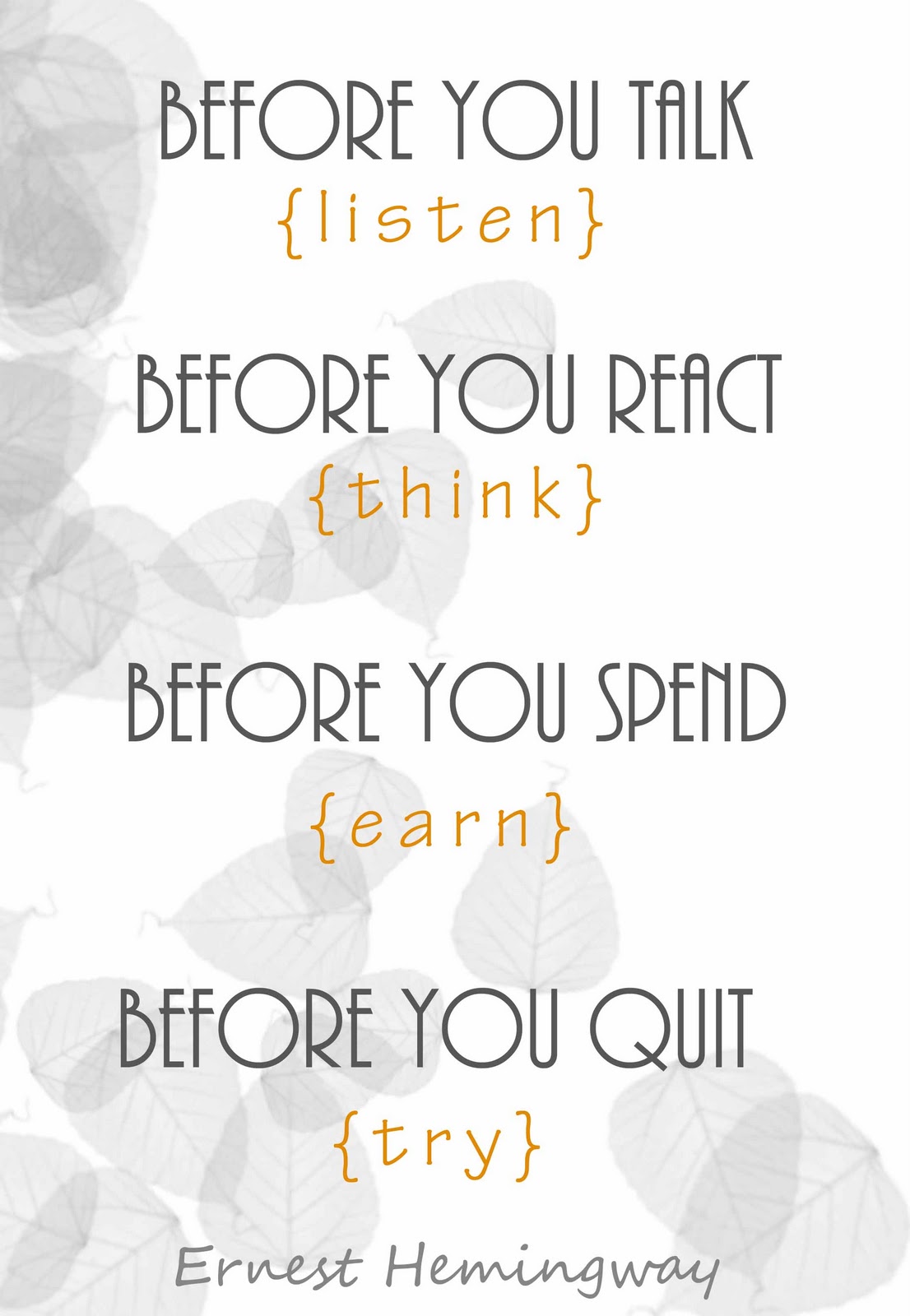
Hemingway’s Star Style, 1915
•Use short sentences. Use short first paragraphs. Use vigorous English. Be positive, not negative.
•Eliminate every superfluous word as “Funeral services will be at 2 o’clock Tuesday,” not “The funeral services will be held at the hour of 2 o’clock on Tuesday.” He said is better than he said in the course of conversation.
•Be careful of the word also. It usually modifies the word it follows closest. “He, also, went” means “He, too, went.” “He went also” means he went in addition to taking some other action.
•Don’t say “He had his leg cut off in an accident.” He wouldn’t have had it done for anything.
•”He suffered a broken leg in a fall,” not “he broke his leg in a fall.” He didn’t break the leg, the fall did. Say a leg, not his leg, because presumably the man has two legs.
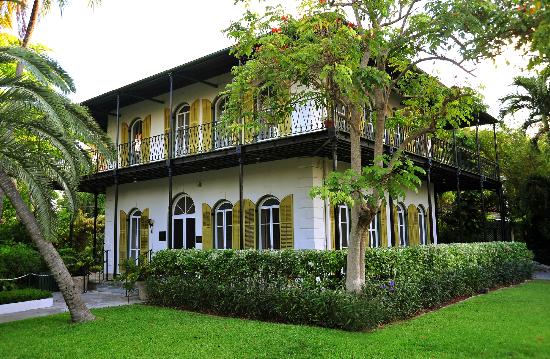
That’s the house in Key West. I step into the little writing studio out back near the salt water pool. I’m told by the guides who give the tours that Hemingway and his wife, I think #3 had frequent fights over the pool. It was a pain to clean and haul the sea water in. I imagine as I walk the grounds, Papa strides to his studio at dawn, locks the world out until noon, heads into town over to Sloppy Joe’s for a few. I wonder at how he is able to live life to the fullest with his hard-drinking, womanizing reputation. And I know he heads to Bimini next for big game fishing, and the evening will end, perhaps 90 miles away at the Tropicana. I see him get up and do it all over again, with a massive hangover, knowing how his story will end, but focused on the now, while still cranking out the greatest novels ever written.
Then I look at the Star Style.
#1. Use short sentences.

a Glimpse at the Real Madame Butterfly

I’m cheating a bit in my title. I do realize but I love a good mystery. Take the romantic tragedy of Madame Butterfly. The story is a classic opera. A few movies. Has inspired several books, including my own, The Secret Life of Concubines. Even Madame Alexander made a doll in her likeness.
But I want to know. Who is Cho-Cho-san?

The story is simple enough. Pinkerton, the naval officer arrives on a ship. Meets a beautiful girl, Cho-Cho-san. They fall in love but Pinkerton leaves her behind, and she waits and waits and waits and waits with unshakable faith, he’ll be back.
But it doesn’t go the way she wants. Enter the tragedy part.

Pinkerton returns. He’s surprised to see Cho-Cho-san is not alone, she has a child. A son who is her whole life. In the words of Malcolm McLaren, Pinkerton’s a bounder. He married a Yankee girl. Which can only spell total devastation for Butterfly. She goes ballistic when she learns he has not returned for her as promised, and…he’s brought his wife. They want her child. Butterfly is destroyed.

It’s a wonderful story, and Puccini’s opera is one of my favorite. But was Madame Butterfly real? Depends on who you ask.

Thomas Glover, a Scottish merchant went to seek his fortune in the Meiji era. He worked the tea trade, and ended up on Nagasaki where he opened his own doors. He was half-adventurer, half-international investor. He took an active role in the Boshin War that toppled the shogunate and built the first western house on the island. He won and lost fortunes a few times over but Glover was first and foremost an industrialist, instrumental in aiding Japan’s rise out of feudal darkness.

He met and married Madame Tsuru. They had a son, Thomasburo. Not much is known about her, accept an old photograph where she is wearing the famous kimono adorned with butterflies. No historical evidence exists that she went by the name Ocho-san (Butterfly). Not a shred, other than the kimono. Historians have deduced that Madame Butterfly was a fabrication of the Nagasaki Tourist Board, even going so far as to rename Glover House, the “Madame Butterfly House.”
Who was Cho-Cho-san?
Who inspired one of the greatest Italian operas?
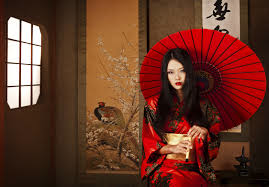
A publicity stunt. An old photograph and a whiff of history. I wonder if Puccini knew that. Somehow, I don’t think he’d care. I don’t care either, I should but it’s a great story. Right?

Fukuyama Castle Matsumae’s Ghost

Japanese winter. Pagoda tiles dripping with ice. Sleeping cherry blossoms encapsulated under snowy blankets busting to flower. There’s nothing like the contrast. On the island of Hokkaido, in Northern Japan, there sits a beautiful little castle on the Matsumae peninsula. It’s quiet, a sentinel in a stark landscape where the wind blows across the stormy Tsuguru much of the year. This castle is nothing special compared to the grand dames Edo and Himeji. It might even disappoint.

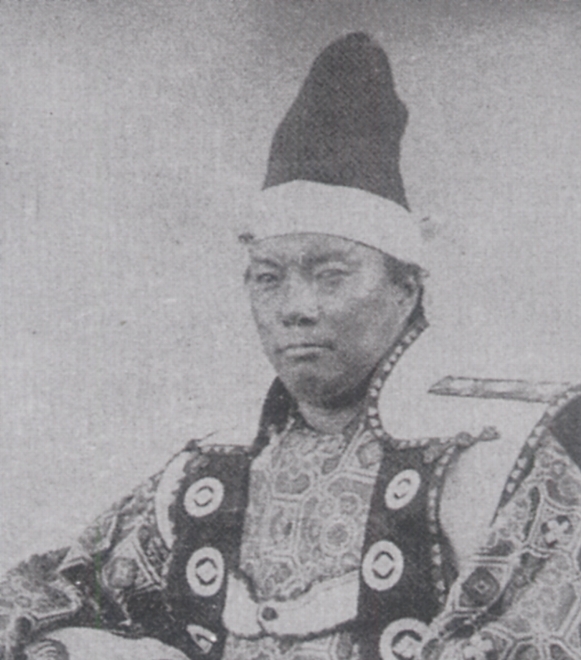
Don’t be fooled. This castle began in a place a castle had no right to be. It’s the only one of it’s kind in Northern Japan and once functioned as the single way station into Edo from the North. The jo began life as Fukuyama castle in 1606 built by Matsumae Yoshihiro. The Matsumae as a clan were tough and pragmatic. They had to be. An offshoot of the mighty Takeda, they were given exclusive rule over the northern island across the Tsuguru Straits.

In exchange, they controlled and subjugated the native Ainu and kept Honshu safe as a bumper. This was unique. Not only did the Matsumae get a rare, free hand, they were not required as most daimyo to make the galling tribute every other year to Edo castle. This allowed the clan to grow wealthy and develop autonomy when most of the other clans were being absorbed.

The life was hard. No rice grew in a landscape that was white most of the year, so the Matsumae adapted. They traded with the Ainu and amassed a vast koku of herring and furs. They were isolated and had little interference from the shogun-until the Russians came down and changed everything. What they found was a clan unlike anything else in Japan. Fukuyama stood less than 100 feet in it’s heyday, with three turrets, and took the name of the clan who couldn’t be frozen out, burned out or defeated easily; Matsumae.

I was so taken with this setting, a castle in perpetual winter and the black diamond clan that I set the action at Matsumae castle in my novel, The Secret Life of Concubines.
Editing and Such

I’m eclectic. I don’t adhere to this way or that way blogging. Today is the letter E in the A to Z Blog Challenge and I don’t have a particular theme. That’s okay.

It’s who I am. At least as a blogger. I like history. I like art. I like culture and fashion. But when it comes to story structure and getting the edits and reedits done, there are no shortcuts. No magic wand, no a little of this and none of that. More like a lot of this and much more of that…and more…and more…and you may be asking how much more? Much More.
Writing is talent for sure, but endurance and sticking to the plan and cranking out the edits are where the writer will stand or fall. When people come to me about writing and ask questions I get excited. I love to inspire newbies with ideas. I listen and watch. I look for the glaze in their eyes when I talk structure. I look for scales falling as I tell them writing is hard and the easiest thing they can do for themselves is learn structure on the front-end.
If they slink away or enthusiasm dampens, I know they won’t make it. If your obsessive enough to stay the course, you’ll get there. Take editing. As new writers we think finishing the manuscript is the end-game, but it’s the first step. If you haven’t taken formal writing classes or workshops, you’ll quickly find that no matter how great your idea, the structure is off. So you begin the arduous task of editing your novel. You learn structure on the back-end.
Maybe you make the draft sparkle with successive passes. You get some guidance under your belt. Maybe you’ve joined a critique group (yeah!), and you’re CPer’s see the makings of a good story.

You’ll have to rewrite that novel, especially if you’re a panzter, over and over many times to get it right. It can be done. The old adage, put the first novel away in a drawer and write another is sound. IF you have no hope of revisiting the manuscript, grow bored with the story (it happens), or didn’t write the thing linear in the first place. But if you love you’re first novel, are committed to reworking it, rewriting it perhaps five or six times, experimenting with POV and flipping viewpoints, you can make that first novel shine. Guess what, it then becomes a third book, a fourth book and a fifth. Only if you study structure and approach each draft as a surgeon.
Resources on Structure
James Scott Bell’s Revision and Self-Editing is a great place to start. Plot and Structure is also a must. What I love about Bell is the ease with which he presents quick fixes and tips that anyone can overcome. The hurdles of learning structure and editing the novel become lighter. Much of what I learned about structure came through the editing process, and seeing what works. Bell’s challenge is the quickest, fast and dirty way to learning story structure that I know. I did it and it was a game-changer.
The Challenge
It’s not easy. Few will have the patience to do it. You might want to give up. Don’t, I promise it works.
Take 6 books you want to read that you admire. Look for a range of works. Ones you’ve read before are fine but read critically. First, read for pleasure. Note what works, what doesn’t. Read again, but this time, deconstruct each scene with an index card, again making note of what worked and what didn’t. You’ll be amazed at how fast you begin to get it. How quickly you apply these principles to others works, how critical you will become and how you will see the flaws in your own story. Now arrange all the index cards novel by novel. If that doesn’t infuse story structure in your mind, if you don’t see behind the curtain, you never will.

Daimyo-Japan’s Lord of the Manor

As a fierce warlord and a ruler, the shogun ran feudal Japan with fear and respect. He was not a king, for Japan had an emperor who held separate court in Kyoto, the ancient religious capital. But the emperor had little power over day to day affairs, and lived a life cut off in genteel seclusion. After years of internal warfare, a leader emerged as the first shogun in 1600. The Tokugawa would go on to rule until the Meiji Restoration in 1868.

But how did the first shogun tame the warring clans into the longest internal peace that would lead to the decline of the samurai? He did it with a road.

A daimyo was a lord. He served under the shogun and swore fealty in much the same way a knight swore obedience to his king. The daimyo, a samurai warlord in his own right, would be given a vast land grant, or han, in exchange for that loyalty to the shogun. Under him would be his personal armies, members of his clan, high-ranking samurai-all at his disposal. This could be worrisome to a shogun who wanted to keep his minions in check. He instituted an ingenious, exhausting system, ensuring the lords would be too busy to concoct sedition. All daimyo were required to travel along the great Tokaido Road in a monstrous procession with everything they owned, from their wives to the last pot and pan. This compulsory trip to Edo Castle took place every other year. All lords were expected to spend the year in service to the shogun at his court-in essence they submitted to becoming hostages.

It was a kind of forced-tribute. The cost to transport an entire household including armies was horrendous. Soon, the daimyo were hemorrhaging money. It took immense planning, many didn’t want to leave their han open to enemies. They resented the shogun’s intrusion and feared consolidation by Edo around the corner. The journey was slow. The main road leading to Edo, called the Tokaido was clogged on any given day with a stream of clan flags waving in the breeze. The servants who could not afford to ride in boxy palanquins walked on foot. No time to plan a war. No time to do anything but go back and forth to Edo, in a slow processional crawl.
It worked. Japan enjoyed peace and the daimyo had other things on their mind like courtesans and pleasure.

With no wars, and no fight, the samurai soon fell upon hard times. The daimyo fortune’s dried up with so many trips to Edo. But a few held out.

Tozama clans-considered outsiders rose up one last time to give the shogun a run for his money in what would become the Boshin war.
 jmledwellwrites